Buying a used car is not about finding one number that settles the decision. It is about making the vehicle’s mileage, past damage, paperwork, seller’s account, and present condition tell the same story. carVertical’s Transparency Index 2026 offers useful context for that approach, but it is based on cars checked through carVertical rather than a census of every used car in the United States.
The practical takeaway is simple: treat a history check as a starting point, then compare it with the VIN, documents, service records, inspection, and test drive. A missing record is not proof that an event never happened, and a record that raises a question is a reason to ask for an explanation before committing.
What the 2026 figures say—and what they do not
According to carVertical’s Transparency Index 2026 for the USA, 4.2% of checked cars had clocked odometers, and the average odometer rollback value was 75,475 km. The same index says 45.56% of checked cars had damage records, with an average damage value of €4,642. It also reports that 47.57% of checked used cars were imported.
Those figures describe carVertical’s checked-vehicle sample, not every vehicle for sale in the country. They do not tell you that a particular listing has an altered odometer, undisclosed damage, or an import history. They do show why it is sensible to verify each of those areas on the individual vehicle instead of relying on an ad, a dashboard reading, or a seller’s general assurance.
Start by matching the vehicle’s identity
Ask for the VIN before spending significant time on a listing. Compare it character by character with the VIN shown on the vehicle and on the seller’s paperwork. If the seller avoids sharing it or the characters do not match, pause the process rather than trying to explain the discrepancy away.
A VIN decoding guide can help you understand how the identifier relates to the vehicle’s basic specifications. Decoding identifies the vehicle; it does not, on its own, establish what happened to it after it was built. For that, you need to review the available history and compare it with the car in front of you.
Keep copies or notes of the listing, VIN, seller’s answers, report date, and documents you were shown. That makes it easier to spot a contradiction when details emerge later.
Check mileage as a timeline, not a dashboard number
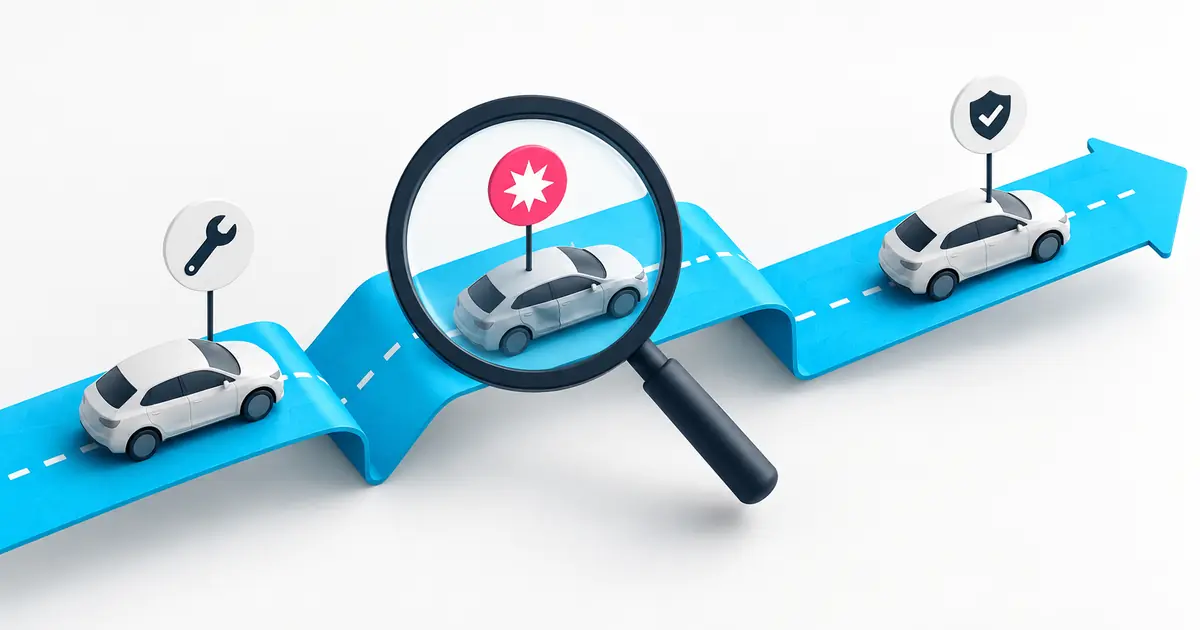
The mileage displayed in the car is only one point in the record. Look for a sequence of dated mileage readings across whatever evidence is available, such as service invoices, inspection paperwork, title-related documents, and vehicle-history records. A sequence that moves steadily upward is easier to reconcile than a gap or a reading that appears lower than an earlier one.
Ask the seller to explain any inconsistency in writing and request the supporting documents. An explanation may be reasonable, but it should be specific enough to check. Do not assume that a tidy interior or a smoothly running engine confirms the mileage.
Mileage also needs context. Read how mileage and age affect a used car’s value alongside the car’s maintenance history and current condition. A vehicle with higher mileage and consistent records can be easier to evaluate than one with a more appealing reading but little supporting evidence.
Treat damage history as a question for inspection
A damage record is not an automatic verdict on a used car. What matters is the nature of the event, the quality of any repairs, whether the paperwork and seller’s account align, and what an independent inspection finds today. Ask what was damaged, when it happened, where the work was done, and whether invoices or photographs are available.
Then inspect the car in good light and during a test drive. Look for inconsistent panel gaps, paint that does not match from one panel to another, water staining, warning lights, unusual noises, and behavior that does not match the seller’s description. These observations do not prove a particular event, but they help determine whether the available history deserves closer investigation.
For a fuller framework, see how accident history affects a used car’s value. Value is only one part of the decision; safety and repair quality matter just as much.
Ask extra questions about an imported vehicle
If a car was imported, establish where it came from and ask to see the documents that support its current identity and ownership status. Check that the VIN is consistent across the vehicle and paperwork. Ask which records are available from before import, whether the seller has documentation for any repairs or modifications, and whether there are gaps in the timeline.
An imported car may have a clear, well-documented history, or it may require more investigation. The import label alone does not tell you the condition of the vehicle. It does mean you should be especially careful about reconciling the history with the documents and physical condition.
Combine a report with independent checks
The U.S. Department of Justice describes the National Motor Vehicle Title Information System (NMVTIS) as designed to protect consumers from fraud and unsafe vehicles and to help keep stolen vehicles from being resold. Its guidance also makes clear that questions about inaccurate title, brand, or odometer information should be directed to the reporting state’s Department of Motor Vehicles. That is a reminder that a report is evidence to investigate, not a substitute for resolving a discrepancy.
Before making an offer, use a sensible order:
- Match the VIN on the car, listing, and documents.
- Review the available history for a timeline of mileage, title information, damage, and ownership-related events.
- Ask the seller focused questions about anything that does not line up.
- Review maintenance records and repair invoices where available.
- Arrange an independent pre-purchase inspection.
- Check for open recalls by VIN and ask how any relevant repair will be handled.
If a seller will not allow reasonable verification, provides changing answers, or cannot reconcile an important mismatch, it is reasonable to walk away. There will be other cars. A disciplined process helps you spend your time on listings with a history and condition you can understand.